
Why Understanding Your Load Profile Matters
- colin2629
- Jun 10
- 2 min read
When businesses experience load stability issues, the first question is often:
"Do we need a different stretch film?"
In reality, that's rarely the best place to start.
Before selecting a film, adjusting machine settings or changing wrapping patterns, it's important to understand the load itself. Every pallet presents its own challenges, and identifying the load profile is often the first step in developing an effective wrapping solution.
Not All Loads Behave the Same
At Load Integrity, we often categorise loads into three broad profile types.
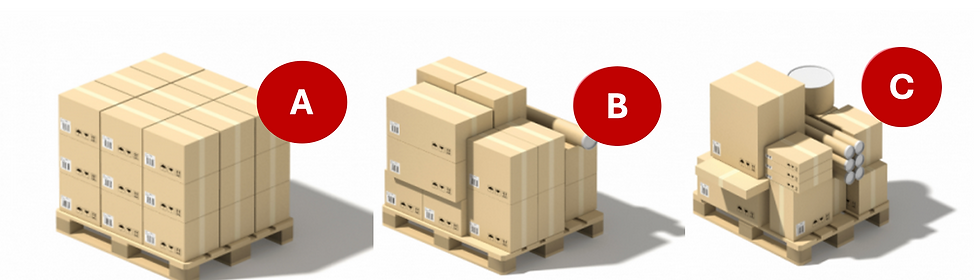
Type A - Uniform Loads
These are the easiest loads to stabilise.
Products are generally stacked evenly, with flat sides and consistent dimensions throughout the pallet. The load has a predictable shape and provides a good surface for the film to contain.
Type B - Irregular Loads
These loads contain variations in shape, height or product positioning.
While still manageable, they require greater consideration when selecting film and determining the correct wrapping programme. Areas of the load may respond differently to containment forces, increasing the risk of movement during handling and transportation.
Type C - Complex Loads
These are often the most challenging applications.
Products may vary significantly in size, shape and weight distribution. The load can contain protrusions, voids or unstable stacking patterns that make it difficult to achieve consistent containment force across the pallet.
In these situations, simply applying more film is rarely the solution.
The Load Profile Is Only the Starting Point
While identifying the load type provides valuable information, it does not tell the whole story.
Other factors also influence load stability, including:
Product characteristics
Pallet configuration
Stretch film specification
Wrapping machine capability
Distribution environment
Handling methods


Comments